Showing posts with label Booklores. Show all posts

Tuesday, 19 May 2026

A Childhood in Malabar—A Memoir


Title: A Childhood in Malabar—A Memoir
Genre: Memoir
Author: Kamala Das
Translator: Gita Krishnankutty
Publisher: Penguin Books
Original titles (two volumes): Balyakala Smaranakal/Varshangalkku Mumbu

Amy's Childhood Encounters with the Raw, Real World of Nalapat

I was in a hurry. I picked up two books on the go. One of them was “A Childhood in Malabar” by Kamala Das. By the way, this bug has got into my system. Of wanting to revisit timeless and modern classics—both movies and books. So when I saw the author’s name, I didn’t give it a second look. I just picked it up, got it issued and rushed out. Let me confess, if I had realised I was picking up the translated edition, I would have looked for the original. Not that I don’t read translated works. (Why would I not since I too occasionally try my hand at translation?) But I would prefer the original if I knew the language. Having said that, I now have no regrets that I picked this book up.

Gita Krishnankutty’s translation flows smoothly. Not for a moment would the reader feel this is a translated version. For me, reading this book gave some learning too on how a translation should sound and feel. While reading, I found myself translating certain words and phrases back to what I felt would have been the original Malayalam. I found this a delightful challenge. But more importantly, this shows how close to perfect Gita’s translation must be.

The memoir is a series of anecdotes which reads like a novel. They give you glimpses of how the young Kamala and her brother tried to find their feet in their native land where they were temporarily shifted to from Calcutta during the times of the Second World War. The reader gets a peek into Kamala’s mind, as she is pleasantly surprised at the conservative and religious ways of the people in the new environs and, at the same time, quietly disturbed at the class and caste differences and discriminations there.

The child’s perspective is maintained throughout the book with all its naivety and curiosity. And the readiness to believe all that one heard in a world that was hitherto unfamiliar to her.

Everyone appreciated the dishes Kunju Nair made. After his death, none of the cooks who succeeded him achieved his standards. People therefore lost interest in food, and apparently this was the most important provocation for dividing the wealth of the taravad later. It was the children of the family who told me these secrets. [P15, para 3]

Childhood memories remain unerased for a reason. They are like torches that light up the path to your future. The childlike wisdom of  young Kamala, who would grow up to become a writer known across the world for her intelligence and individuality, is evident in what she captured and held in her heart right from when she started noticing the world around her.

There were two types of people in our village at that time: a group who thought of truth as lies and another that thought of lies as truth. Both groups were entangled in a web of fallacy. [P63, last para]

The narrative flows at the same slow pace as that of the life in a traditional taravad of Kerala. The calmness on the surface is deceptive, as it hides the turbulence underneath. The author deftly—and subtly—brings this out.

‘She is not afraid of anything because she lives in Calcutta. She doesn’t even know snakes are poisonous! No one’s explained these things to her either,’ said Kali Narayanan.

‘Let her grow up like that, not knowing fear,’ said Ammamma. [P172, paras 2 and 3]

Among many things that fascinates me as a reader is the author’s creative brilliance in bringing out her slow discovery of her own roots as a child and then her gradually growing attachment to the place, its people and their ways. Her attachment to her Ammamma lurks between the lines through the entire narrative.

‘Won’t we take Ammamma to Calcutta?’

‘How can we take her? Doesn’t she have to look after things here? She’ll stay in the village. I’ll take you with me and make you an elegant, fashionable girl. Right?’

At that moment, I dreaded the city and its fashionable ways, the circus, everything… [P130, paras 1,2,3]

Kudos to Gita Krishnankutty for preserving all the understated emotions in the stories intact. The translation reads like it was the original, while it retains the regional flavour of the original. Every word and line of this charming memoir was a heart-warming read.

©


Friday, 16 January 2026

Samalkot Station & Other Stories


Prose, or poetry, or something beyond?

Title: Samalkot Station & Other Stories
Author: Sindhoor Varkoor
Genre: Short Stories
Publisher: Notion Press
Stores: Amazon, Flipkart, etc.

The sea spoke in murmurs only the heart could hear, wrapping me in its rhythm.

In those moments, I moved like the mermaid – as though born from salt and story. [p.83]

Sindhoor Varkoor’s Samalkot Station & Other Stories hover somewhere between prose and poetry. If at all you have to give them a name, you may call them haibun. Let me confess, I have just a smattering of the Japanese formats of writing. That being said, is it essential every piece of writing is categorised or labelled as one genre or the other? No, not really. Not when you are thoroughly enjoying the read anyway.

There’s something about wood that I have always loved – it smells of forests, of damp roots buried in rich earth…That old almirah wasn’t just furniture; it was memory, magic and meaning all woven together. [p. 14]

The short verse that follows every story carries the entire spirit of the story in a few lines. Varkoor’s prose has the feel of poetry. It touches you like a cool gentle breeze on a warm summer afternoon. Her poetry stirs something inside you so you want to read it again, and again. And then it settles you, soothing your soul. The reader doesn’t realise when the prose transcends to poetry.

flowing stream
stones settle
down
unsettled [p.36]

The stories sound personal – personal not only to the writer but also to you as a reader. Not that you have gone through similar situations as her protagonists, but because you feel you belong to their world.

alarm…
her anklets
wake up the household [p.46]

There’s something personal for me in the above poem, though. This reminds me of my own childhood days when my Ammamma’s click-click of her flip-flop, as she busily walked down the central corridor of our home, woke us up as we tried to sleep in on Sundays. Her story and poetry renditions still ring in my ears like music. But enough of that. This is about Varkoor’s stories. But you get my point. This author’s stories resonate with the reader. There is something in them that may sometimes evoke a memory and sometimes echo your thought.

This is Amma’s world – the mango tree, the neighbour’s woes, the gate, the creaky chair, the echo of footfalls that no longer return. [p.17]

The story “Amma Maatalu” brought tears to my eyes. And so did the concluding poem. There’s more in the poem than its words.

death anniversary
crows gather as
mom folds
dad’s black coat
into silence [p.17]

The author uses common threads of ordinary life to weave enchanting narratives. “Shraddha Extension” is a subtle story set in as commonplace an environment as a busy (probably kids') store.  The setting could as well be a slice from anybody's life. But the magic of the author's storytelling brings out the emotional impact of the moment.

Varkoor’s way of writing appeals to all your senses. The music of the sea, the fragrance of freesia, the flavour of tea, the vision of the "shreds of peacock-blue silk hanging like wounded feathers" – you can experience them all and suchlike in her writing.

The book, with its illustrations, looks charming to say the least. Viswaprasad Raju’s sketches have captured the soul of Varkoor’s narrative. As with the poems, there’s more in the pictures than their lines.

©


Saturday, 5 July 2025

Did I Really Do All This?


Book Title: DID I REALLY DO ALL THIS?
Genre: Memoirs
Author: Vijay Raman
Publisher: Rupa Publications India Pvt. Ltd. 

As an Indian living far down South, my first impression, as a kid, of the Chambal Valley was thanks to India’s iconic silver screen villain, Gabbar Singh, in the epic film, "Sholay". Apart from that, my childhood memories of a few train journeys, crossing the Valley, remain distant and vague. And then came Shekhar Kapur’s "The Bandit Queen", by which time I was an adult. The movie left me, as it did many others, disturbed. Of course, there were many other films too made on the baddies of the badlands, but they never reached the theatres of the South. And somewhere in between, I got to read about the daring, swashbuckling Vijay Raman IPS’ intense, gruelling encounters with the dacoits of the Chambal Valley. Those were real-time stories, and he was, undoubtedly, the real hero. Ever since I got to know about the book, “Did I Really Do All This”, I was looking forward to reading it. The book throws as much light on the man, the author, as on his illustrious career as a high-ranking police officer.

In contrast to the typical image of a policeman, Vijay Raman IPS, obviously, was a kind, compassionate, sensitive, and easily approachable police officer. Several incidents in his career, as revealed in the book, are testimonies to this. However, much remains unsaid, unwritten, or so this reader feels. Much is left to be read between the lines. There is much more to the man beyond the surface. Buried deep within him, and such guardians of law, must be a burden of emotions – the leftovers of many a job done well. This anguish is a huge sacrifice made by them, perhaps known only to them.

“One day, I received a report of the discovery of an unidentified dead body. Somehow the name of the place, which fell under the police station of Pandokhar, rang a bell, and I found myself rushing anxiously towards it with a growing sense of dread. It was about 100 km from Gwalior and by the time I got there, the body, though badly mauled and with limbs dismembered, had been identified. Beside it sat a woman clutching two children tightly to herself and wailing loudly.

It was a terrible, terrible feeling to know that this was my fault. I was responsible for the death of this informer. I was the person responsible for all those who were killed by Devi Singh after his release, until he was terminated by my junior, SP Asha Gopal. It would always remain on my conscience that my actions, though purely with the intention of upholding human rights and protecting human life, had led to so much violence and misery.” (p. 48)

When the author looks upon his own actions objectively, he is harsh on himself, but not in the least does he flinch from facing what he believes is the truth, albeit bitter.

“I did feel flattered by his description of me, and the objective way in which he reported what I had told him: my understanding and sympathy for dacoits as human beings that later became influenced by the suffering they wreaked on the villagers and seeing my own men crippled and killed in encounters. I told him that when I dealt with dacoits, I had to become as dehumanized as they were, shedding all sensibility, becoming exactly what my enemy was. I did not like it, but it happened.” (p. 58)

At the end of it all, after all the sacrifices and criticisms, does the law enforcer feel it was all worth it? Perhaps yes. But with some misgivings. The author speaks about the flip side, or the “alternate and rather harsh reality” of his encounter with Paan Singh Tomar which led to the decimation of Tomar and his gang.

“…to the media across the world and in India too, it was a hero who had been brutally gunned down. Paan Singh had served in the Indian Army. He had won athletics medals for India. When he returned home to his village, the disparities and inequities of Indian society had given him no choice but to turn to dacoity. The media focused on these, and this gave rise to huge sympathy for Paan Singh and even contempt for the law-keepers who had gunned him and his gang down. There was no mention of the fact that, in the course of our duty, and at great risk to our own lives, we had removed a dangerous criminal and his gang from the face of this earth. However, the people of Chambal and its surroundings, who had lived in terror of the gang’s burglaries and abductions, were deeply grateful for the capture.” (pp. 76-77)

The series of incidents that led to the execution of the bandit and his coterie is no less gripping than a suspense-filled silver-screen thriller. But one shouldn’t excerpt them here and spoil the surprise of a prospective reader.

And with as much as a few words, in an aside, Vijay Raman dispels the myths created by the movies around the highly romanticised, heroic image of the bandits.

“In those days, no dacoits in Chambal were going around on horseback. They were all walking. The movies have depicted this incorrectly. There were no horses, and there could not have been horses, because horses meant expenditure; they meant money. Where would the fodder for a horse come from? Where could the money come from? Every source of money could be detected. At night, when a gang is surrounded, you can tell your men to be silent, but can you keep your horses silent? The horses will neigh. And horses are easy to track, by their excreta, among other things. The dacoits do not ride on horseback – they walk. They walk through the ravines. I know that Malkhan used to walk every night, often as much as 22 km!” (pp. 61-62)

How the poor viewers’ lack of common sense is being taken for granted continuously by the filmmakers. One wonders how all those movies turned out to be the blockbusters they were. How far away are the general public from reality!

As one reads on, one realises that this “simple, straightforward” cop commanded the respect of even the lawbreakers. Take for instance Malkhan Singh’s surrender. Vijay Raman didn’t just defeat his opponent but won him over.

“That was the day on which a dacoit from the ravines of Chambal came to Delhi, made enquiries to find out where I lived and, when he found out, climbed eight floors (lifts scared him!) to come to my home (adorning a tilak, holding a gun!) to pay me a visit. He had honoured me with his rituals (touching feet, offering tilak, paying Rs. 101 shagun!), assuring me that, despite being on opposite sides of the law, despite my holding out relentlessly against him, he had always held me in respect and continued to do so.” (p. 112)

The author’s deceptively stoic recountal of the gruesome scenes that unfolded before his eyes following the Bhopal Gas Leakage, as he rushed back and forth between the hospital and the railway station, trying to make sense of the traumatic effects of the Tragedy and deal with them, makes it all the more heart-wrenching.

“The entire platform, a huge expanse, was filled with dead bodies. They were lying helter-skelter, as they had fallen, and I could see many corpses with intestines spilling out of the anal area. I did not allow the dreadful sight to affect me – it was my duty to find someone here who could tell me what had happened. I walked around to try and locate a person who was still alive, but could not.” (p. 122)

Vijay Raman’s portrayal brings out the writer in him as he makes the situation come alive in the reader’s mind so much so that they can see, feel and hear the panic.

“As they ran, people panted, struggled for breath, and inhaled even more than they would have if they had not ran! That image of people running for their lives, and the very act of running taking them closer to death, is one that will never leave me.” (p. 123)

This super cop’s daredevilry and adventure was not confined to his job, which was, as it were, adrenaline-fuelled. He was also full of fun and frolic. What else could have taken him around the world, along with his friend, in a Contessa in less than 40 days to earn a spot in the Guinness Book of World Records! He narrates the tour hour by thrilling hour, without leaving out any of the delightful surprises (or the rude shocks!) that popped up on the way. From the preparation for the tour to the receipt of the certificate, he relates, at length, the tiniest of details.

The passages quoted above are but a few, fleeting peeks into the book, which is replete with revelations on the action-filled life of Vijay Raman, the outstanding police officer who was also a remarkable human being. The list of his achievements and accomplishments are long, and include the liquidation of the mastermind behind the 2001 Parliament attack, Ghazi Baba, giving protection to four Prime Ministers of India, initiating the fencing of the Indo-Pak border, and so on and so forth, each one more engrossing than the other.

The book leaves the reader in awe of this dauntless man who had put his life at risk and had a brush with death, not once but several times, for the security of the nation and its people. His writing style is incredibly unassuming for a man who had created history at about every turn in his life.

In closing, one wonders if this note has turned out to be more about the man than about his book. Perhaps Vijay Raman was a man who couldn’t be separate from his purpose, his duty, or his actions. The more one reads into the book, the more one feels he identified himself with all three. His wife Veena Raman’s anecdotes throw more light on the personal side of this legendary man. You close the book with a sense of sadness, though. The author left this world before he could see his book published. But then, perhaps, it would have hardly made a difference to him, the karmayogi that he was.

©

Wednesday, 23 April 2025

Legends of the Hill


Title of the Book: Legends of the Hill
Author: Ruskin Bond
Genre: Stories
Publisher: Rupa Publications India Pvt. Ltd.

Everyday life and things are not as commonplace as they are made out to be. There are quaint, interesting, intriguing stories lying hidden in them. You just need to have the eye and ear for them. Ruskin Bond sees the extraordinary amidst the very ordinary. And he weaves amazing stories around them.

In “Legends of the Hill”, Bond’s writing flows like a mountain breeze. It carries the fragrance of the forests and the echoes of the valley. Characters are incredibly natural. Even the ghosts are like normal beings. There is no suspense built up around them, for they are part of the environment, the people, the setting.

The author often writes about little things – deceptively unimportant things – that make up charming stories – stories that recreate the life on the hills.

“Had it all been a dream, that strange episode on Pari Tibba? Had an overactive imagination conjured up those aerial spirits, those siddhas of the upper air? Or were they underground people living deep within the bowels of the hill? If I was going to keep my sanity I knew I had better get on with the more mundane aspects of living – such as going into town to buy my groceries, mending the leaking roof, paying the electricity bill, …” [p. 59]

It is interesting to note that while the author refers to the safety and sanity of ordinary, “mundane” things, his stories on ordinary people and their ordinary lives get the readers’ eyes glued to the pages. The reader is captivated by the beauty in the mundaneness, so to say.

“The truth is, what we commonly call life is not life at all. Its routine and settled ways are the curse of life, and we will do almost anything to get away from the trivial, even if it is only for a few hours of forgetfulness in alcohol, drugs, forbidden sex or golf. Some of us would even go underground with the fairies, those little people who have sought refuge in Mother Earth from mankind’s killing ways; for they are as vulnerable as butterflies and flowers. All things beautiful are easily destroyed.” [p. 59]

The author paints pretty pictures with his words. I wished I were an artist when I read this book. Why, I could have created a whole gallery of pictures inspired from his writings!

“The train would reach Deoli at about five in the morning when the station would be dimly lit with electric bulbs and oil lamps, and the jungle across the railway tracks would just be visible in the faint light of dawn. Deoli had only one platform, and office for the stationmaster and a waiting room. The platform boasted a tea stall, a fruit vendor and a few stray dogs; not much else because the train stopped there for only ten minutes before rushing on into the forests.” [p. 61]

The author continues to write about the railway station. If you are the kind of person who have felt a strange connect with lonely places (I am), and if you feel something stirring within you if you see a quiet, unpopulated place like a railway station (I do), then you will instantly relate to the following passages.

“Why it stopped at Deoli, I don’t know. Nothing ever happened there. Nobody got off the train and nobody got on. There were never any coolies on the platform.

I used to wonder what happened in Deoli behind the station walls. I always felt sorry for that lonely little platform and for that place nobody wanted to visit. I decided that one day I would get off the train at Deoli and spend the day there just to please the town.”
[p. 61]

As the author narrates a story, he leaves so many stories untold between the lines, urging the reader to take off on their own imagined tales. Often, the author leaves his own story midway, happy to hang on in a state of expectation, revelling in the joy of anticipation.

“In the last few years I have passed through Deoli many times, and I always look out of the carriage window half-expecting to see the same unchanged face smiling up at me. I wonder what happens in Deoli, behind the station walls. But I will never break my journey here. It may spoil my game.

I never break my journey at Deoli but I pass through as often as I can.”
[p. 66]

Stories have a way of conveying the simplicity of the common folk. Especially when Ruskin Bond narrates them. It’s right there in front of your eyes in all its innocence and charm. Exposed, naive, vulnerable. Like a dainty, delicate bubble. Your thoughts hover on it and move on. You might as well not touch it, lest it burst. You leave it well alone.

Won’t you feel scared returning alone?’ he asked. ‘There are ghosts on Haunted Hill!’
‘I’ll be back before dark. Ghosts don’t appear during the day.’
‘Are there lots of ghosts in the ruins?’ asked Binya.

‘Because, Grandfather says, during a terrible storm, one of the houses was hit by lightning, and everyone in it was killed. Even the children.’
‘How many children?’
‘Two. A boy and his sister. Grandfather saw them playing there in the moonlight.’
‘Wasn’t he frightened?’
‘No. Old people don’t mind ghosts.’
[p. 68]

Have you ever looked at a beautiful picture, be it a painting, drawing or a photograph, and felt like going to that place in the picture? I have, always. And I am stirred by the same feeling when I read Bond’s stories. I want to be in that place, among those people, walking down the roads there, feeling the air, listening to the sounds of the people, the birds, the wind, the trees. Drinking in all the sights. Capturing moments and storing them in my mind forever.

©

Saturday, 22 March 2025

Human in Economy: The Social in the Science


Title of the Book: Human in Economy
Author: Sivadas R. Warrier
Genre: Non-fiction
Publisher: Tureeyam Media
Book Stores: Amazon, Flipkart, Google Books, Bookscape

This write-up has taken a long time in getting written. Often, it’s like that. You write something in your mind several times, then rewrite, revise, and refine it. But you never get around to putting your pen to paper or, rather, your fingers to the keyboard, to see your thoughts manifest in a scribble. However, when the subject remains as fresh as ever, and the experience refuses to lose its flavour, the urge to write gets the better of you. Thoughts re-form and words get re-phrased.

Human in Economy. The title is intriguing. The content is simple and straight-forward. The author is as unpretentious as can be in his writing. Both, the author and his book, don’t claim to be anything they aren’t. They don’t project themselves to be more or less than what they are. Simply put, the author is as unpretentious as he is unapologetic. The narrative or the story-telling approach keeps the reader connected to the book, as the thread of interest remains unbroken.

The narrative is set in two towns, Coimbatore and Thrissur, which lie on either side of the Sahyadri – the Western Ghats. The book recounts biographical sketches, and events and anecdotes from the lives of two karanavars – male heads – of two families who lived in the said cities. It talks about their impact on the different societies they lived in – their role in the sustainability and growth of their families and the communities that surrounded them. Two different people in two different settings – what is common in them is their selflessness, their perseverance, and their distinct social consciousness.

The author writes about what he has seen, heard, experienced and understood. He writes about times in the past that had solutions to potential economic challenges interwoven into the fabric of life. The solutions, the reader realises, were so taken for granted that later, the people lost sight of the problems, and the solutions gradually became a tradition, a custom, a practice.

As the author traces the growth of the economy, especially in the Indian context, he throws light on how, in the pursuit of modern science, man let go of his ancient wisdom. He writes:

The sacred was removed from science. And science came to be known as secular knowledge. The intention should have been the removal of the religious influence on science, however, they removed the mysticism as well. It was like throwing the water out along with the baby.

Today, we have increasing number of questions on what a good economy looks like and how to get there, but the answers are elusive. And there lies the relevance of this book – where many of these questions and answers meet.

According to the author, economics is human behaviour. Deriving from the knowledge imparted by the seers and masters of all times, the author writes:

The culture and civilization of a region are inseparable from its economics. Economics, as a human science, has also to be lived – as true human behaviour. People learn what they are taught and behave as per what they imbibe.

"Human in Economy" is, obviously, about economics. But the account is autobiographical and weaves into its narrative slices of history of a particular region, its geography, the social structure of a section of its people, and glimpses of the culture and lifestyle they followed. The narrative is strewn with insights into Indian spirituality and philosophy, and excerpts from the ancient scriptures. For someone (and that’s me) who believes in the unity – the oneness – of knowledge, this book is a simple reaffirmation of how the various disciplines – the branches of knowledge – are interconnected and interdependent. The more you delve into knowledge, the more you see the lines that divide it into different specialities getting thinner and finer, until, perhaps, they fade.

The author does not dwell on past glories. Rather, he’s trying to pave a way into the future. Economics, as he perceives it, is not about being frugal at the cost of enjoyment, nor is it about being indulgent at the cost of well-being. It is not sustainability at the cost of growth. It is not at all about philanthropy at the cost of profit. It is none of that, nor vice versa. It is about creating wealth and preserving it in the society. It is about creating wealth for yourself, while you also help others create wealth. This apparently should be, the reader understands, an individual’s constant, conscious endeavour as well as their subconscious, habitual behaviour in an economy.

Warrier navigates from the past to the future, from the scriptures to science, and from tradition to technology without ever losing focus on the purpose of his book. His narrative never deviates from the essential theme of the book. This in itself is a feat.

That the book is the first volume of the tetralogy, The Indic Roots, gives the reader much to look forward to.

©


Thursday, 7 March 2024

i came upon a lighthouse


Title: i came upon a lighthouse
Author: Shantanu Naidu
Illustrations: Sanjana Desai
Publisher: HarperCollins Publishers India

“i came upon a lighthouse” is a book about the most unique, unusual, and unlikely friendship between an octogenarian (Ratan Tata) and a twenty-something author (Shantanu Naidu). The book is as charming as I expected it to be. Illustrations by Sanjana Desai add to the charm.

Though the author says – almost like a disclaimer – that “the pages of this book are the result more of heart and story and less of artistic capability”, the story, which is a true one, reads as smoothly, gently and softly as any good fiction. The two friends meet because of a common trait – their compassion for homeless dogs. And the meeting evolves into a rare kind of friendship where the elder of the friends become a guide, a mentor and a companion-on-call for the younger. And a confidante and an anchor when the latter finds himself alone and lost in an alien land. 

“Everyone has their own layered relationship with New York City. It is a relationship with a living being, an actual person. Each visitor has their own version, their own narrative. Everyone is hustling, trying to make it, whether in life or through the day. It is overwhelming to be on the sidewalk with people who are always anxious to be somewhere. When everyone around you has a purpose in the city, it is lonely to be there without one.”

The beauty of this friendship is in the sweet innocence of the friends and their refreshing candour. Their relationship becomes a subtle, non-intrusive influence in the young man’s life, helping him find his feet in his confused world. That he has access to one of the greatest, one of the most brilliant, minds of India makes the relationship even more special, rather, enviable, to the readers. 

“Why don’t you come with me to the World Trade Center office tomorrow. You can see the slums surrounding the campus from the twenty-sixth floor. It is a disturbing difference, a mismatch of classes. But you can also see how organically they are mapped, how there is pattern to the chaos.”

I am grateful to the author for writing this book, for it brings out the unseen, unknown, and unheard-of (at least to the general public) personal side of one of the most admired and respected citizens of the country. And what I find is less of a surprise and more of an affirmation or a reassurance. 

The friendship of this pair – the youth and the youthful – restores your faith in honest, genuine, selfless friendships where almost nothing stands as a barrier between friends. The aura of their friendship lingers long after you have finished reading the book. You are happy to be caught in its spell, and remain so.


Thursday, 13 July 2023

Arddhanagnar - The Half-nakeds


Book Title: അർദ്ധനഗ്നർ (Arddhanagnar)
Author: Puzhankara Balanarayanan
Publisher: Current Books

കൃഷ്ണൻ നായർ ആദ്യവരിയെഴുതി: "മൈ ഡിയർ ലിസ്സ്" അത്രയും എഴുതിയപ്പോൾ മനസ്സ് സ്വസ്ഥമായി. തുടർന്നെഴുതി:

"ഒരുമിച്ചൊരു മുറിയിൽ കിടന്നുറങ്ങി പാതിരാത്രി കഴിഞ്ഞപ്പോൾ പെട്ടെന്നെഴുന്നേറ്റ് ഉറങ്ങിക്കിടക്കുന്ന പ്രിയതമയോട് മൗനമായി വിടപറഞ്ഞിറങ്ങിയ സിദ്ധാർത്ഥഗൗതമൻ്റെ കഥ നിനക്കറിയാമല്ലോ. പലപ്പോഴും നാമത് ചർച്ച ചെയ്തിട്ടുള്ളതുമാണ്. അങ്ങിനെയൊന്ന് സംഭവ്യമാണോ എന്ന് എത്രയോ പ്രാവശ്യം സംശയിച്ചതുമല്ലേ? എന്നാൽ അത് സംഭവ്യമാണെന്ന് ഞാൻ മനസ്സിലാക്കുന്നു. പെട്ടെന്ന്, തികച്ചും അപ്രതീക്ഷിതമായി ഞാൻ നിന്നോട് വിട പറയുന്നു. സിദ്ധാർത്ഥഗൗതമനും ഞാനും ഒരേ തരക്കാരല്ല. പക്ഷേ, ഒരു വലിയ അന്ത:ക്ഷോഭത്തിൽ ഞാൻ ചെന്നുപെട്ടു. വിടപറയാൻ നിർബ്ബന്ധിതനായി. നിൻ്റെ കത്തുകളിൽ പ്രകീർത്തിച്ച അർദ്ധനഗ്നനായ ഫക്കീറില്ലേ? അർദ്ധ നഗ്നൻ എൻ്റെ മനസ്സിൽ കയറിവന്നുനിന്നു. അതുപോലൊരു അർദ്ധനഗ്നനാകണമെന്ന് എനിക്ക് ഉൽക്കടമായ ആഗ്രഹം. അത് സാദ്ധ്യമല്ല. പക്ഷേ, ഞാനിന്ന് അദ്ദേഹത്തിൻ്റെ  ആരാധകനും അനുയായിയുമാണ്." 

Some books make you wonder what took you so long in getting around to reading them. Especially when they were lying so close within your reach that you could have just stretched your hand out to pick them up. But you always thought they were downright serious works and you wished to spare enough time to do full justice to them.

And then one day you open one such book – Arddhanagnar (The Half-nakeds) by Puzhankara Balanarayanan – and no sooner than you begin turning the pages, you find yourself getting wrapped up in them. You realize that the book is unputdownable. You sit up late in the night reading it. And the first thing that you do in the morning along with getting your cuppa is getting back to where you left off reading the previous night. You don’t realize your coffee is turning cold. Indeed, you don’t even realize you are not drinking it in the first place.

And then after the brisk, marathon poring-over and the nail-biting finish, you feel the satisfaction of a good read and the contentment that you have, after all, done full justice to the voluminous page-turner packed with a plot that has kept you on the edge of your perch from beginning till end.

And to those who have not read the book – no, this is not a suspense thriller. This is fiction closely interwoven with the history of India during the times of the Raj and the Freedom Struggle. The history is true and the fiction could as well have been true. For, the story reflects the socio-political economic context of those times. Travel back into the era, and you will meet up with different versions of Velu Nair, Krishnan Nair, Sekharan, Madhavi Amma, Gouri, Elizabeth Trevor, Kurup, etc. who lived similar lives in similar circumstances.

The novel is about native landowners discovering too late that they themselves were owned by the (British) Empire. It is about Indian aristocracy vying with the English aristocracy only to lose their own inherent charm and integrity. It is about the different circumstances that roused the sleeping Indian out of their prolonged stupor to break away from the shackles of serfdom, to be bound to the cause of freedom. It is about the desi turncoats stripping themselves of their garbs of delusion to don the nakedness of truth.  

The author, Puzhankara Balanarayanan, has interwoven fiction and history so smoothly that there are no complicated, confusing knots, or loose, dangling threads in the narration. While the story moves you, the historical anecdotes inspire you even today – more than 7 decades and a half post independence. Take, for instance, the author’s step-by-step detailing of the Salt March – you, the reader, wait with bated breath as the "half-naked fakir" marches from station to station until he reaches the final destination  – Dandi. So what if you have always known the culmination and the aftermath of the Movement anyway? Adding to the reading experience is the author's exceptional expertise in building up climaxes and then taking you off on completely unexpected tangents.

Today, days after reading the book, this reader still remains caught in the web of the author’s spellbinding and powerful narrative.

©


Thursday, 6 July 2023

Saaramilla – It’s Okay


Book Title: സാരമില്ല (Saaramilla)
Poems by: Jayasree T.
Illustrations by: Basanth Peringode
Published by: Thinkal Books

I had been losing myself in the pages of Saaramilla (It Doesn’t Matter) when I came to and felt that I should put down here a few of my thoughts on this amazing book. However, I feel slightly awkward, writing in a foreign tongue about a profoundly beautiful collection of poems in Malayalam, my own mother tongue. But, as the poet says, it doesn’t matter. It’s okay. Saaramilla. I’ll do this my way.

Most of Jayasree’s poems in this collection are short. Some are shorter. The shorter her poems, the more powerful and potent they are. Let me throw in here a few of her verses along with a quick and free translation of them just so that I can connect with my non-Malayali readers as well.

വെളിച്ചമടിച്ചാലും
ഒരു പുറം
ഇരുട്ടിലാവുന്ന
തിരിച്ചിലാണ്
ജീവിതം. (രാപ്പകൽ)

Much as light falls/there’s a side/that slips into the dark/in this whirl/of life. In this poem, Rappakal (Day and Night) the poet, in a brilliant stroke of a single sentence, brings out the laborious cycle of life and the passing of time. A few words put together connect the subtle contrasts of life. The lines are powerful and they hit you before you know it. The poem is like the tip of the metaphorical iceberg. There's massive truth submerged beneath the surface layers.

വാക്കുകൾ
വരിവെച്ച് പോവുന്ന
നിൻ്റെ ഉൾത്താളുകളിൽ
എൻ്റെയൊരു
പാഴ് വാക്ക്
വീണു പോയിട്ടുണ്ട്
വായനക്ക് കരടാവാതെ
അതെടുത്ത് കളഞ്ഞേക്കൂ. (വായന)

Another brilliant verse – Vaayana (Reading) – that made me stop short and go back to reading it again and again. Amidst the words/that line up/in your inner pages/a wasted word/of mine/has randomly fallen/pick it up and throw it away/lest it spoil your reading. The deeper I dive into the layers of these lines, the higher I soar in the skies of my imagination. This is the kind of poem that once written, a poet would feel content forever.

വെയിൽ പൊട്ടിത്തകർന്ന
നിഴൽപ്പൊട്ടുകൾ
പെറുക്കിപ്പെറുക്കി
കൂട്ടി വെച്ചാണ്
പകൽ
രാത്രിയുണ്ടാക്കുന്നത്. (രാത്രിയുണ്ടാകുന്നത്)

Raathriyundaakunnathu (The Making of the Night) presents a chiaroscuro with words – and yes, that's possible. Sunlight broken up/into bits of shadows/are picked up one by one/and put together/by the day/to form the night. The poem at once brings to mind a thousand collages of light and shade, each like a jigsaw puzzle, breaking up and joining back again to make a new picture. The poem ends too soon leaving infinite pictures forming and re-forming in your mind.

എത്ര ഇല വിരിച്ചിട്ടും
പൂത്തുലഞ്ഞിട്ടും
ഞാൻ
പിഴുതെറിയപ്പെടുന്നു. (കള)

Kala (Weed) could be a nature-lover’s lament. Especially my kind of lover who is perpetually fascinated by the weeds with their perennial blooms and die-hard foliage. Spreading leaves aplenty/blooming all the way/I am still plucked and tossed away. But rake the lines a bit, and you see much more than weeds lurking between them.

And so on and so forth. Jayasree’s poems have many such gems hidden in their depths. The poems are well illustrated by Basanth Peringode. The book is well designed and well produced by Thinkal Books. I wish Jayasree’s book wide readership and her pen more power and poetry.

©

Friday, 4 February 2022

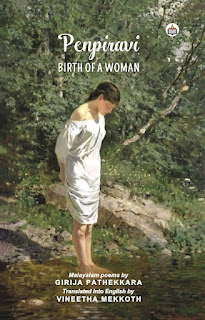
Penpiravi - Birth of a Woman: She could be you, but she's me too.


Title: Penpiravi – Birth of a Woman
Translation by: Vineetha Mekkoth
Poems by: Girija Pathekkara
Published by: Authorspress

“Penpiravi – Birth of a Woman”, a collection of poems by Vineetha Mekkoth, is a translation of Girija Pathekkara’s collection of Malayalam poems of the same title.

Through the entire reading of the book from cover to cover, I was aware of the presence of a woman who is very bold and progressive in her thinking, but very docile in her personal everyday life. A docility that she hangs on to, perhaps, out of her emotional attachment to those around her. A docility that can, like a sleeping volcano, erupt at any moment. A docility that can turn into a powerful force, which she essentially is, at her own free will. A docility that she can do away with anytime if she so chooses. That woman, I feel, is perhaps the poet. And, that woman, I know for sure, is me.

As a reader of poems, I believe the order of the poems in a collection plays an important role in how the readers experience them. In the poem “Ichchamati”, which is brilliantly placed as the concluding poem in this collection, I could see the beginning of the woman’s transformation into what she would and should become. However, I neither see the explosive awakening of a sleeping volcano nor a vehement unleashing of the power of her will. What I see is a gentle unfoldment that is as gentle as the metamorphosis of a butterfly or the blooming of a flower.

“…Does the water
have eyes to see
the way it has to flow?

My little question
then you answered
with so many kisses.

Yes,
water is
a freedom-loving
woman,
mother, you had
answered then.

Here now
before me
is Ichchamati.
May I step into her now?”
(p. 76)

Ichamati is a river that flows between India and Bangladesh. Roughly translated, the word ichamati means “someone who moves (lives) by her own wishes”.

I take my hat off to Mekkoth for preserving the experience of the poems. She has maintained the spirit of the original language, Malayalam, without compromising the beauty of the target language, English. Mekkoth has also been able to present the cultural setting of the original poems effortlessly. Having said that, the poems don't lean on the original versions to connect with and delight the readers. They are beautiful poems in themselves that can enchant lovers of poetry across the world. Well, simply put, I enjoyed reading the book.

I wish Vineetha Mekkoth and Girija Pathekkara the very best on their poetic journeys.

The book is available at https://www.amazon.in/Penpiravi-Birth-Malayalam-Girija-Pathekkara/dp/B09HQ24CKJ/ref=sr_1_3?qid=1643973024&refinements=p_27%3AVineetha&s=books&sr=1-3.

Friday, 3 December 2021

The Brahmmastra - Unleash Your Hidden Power to Heal


Knowledge – the Ultimate Weapon

Book Title: The Brahmmastra – Unleash Your Hidden Power to Heal
Author: Dr. A. Sreekumar
Publisher: Authorspress
Bookstore: Amazon

“The Brahmmastra – Unleash Your Hidden Power to Heal” by Dr. A. Sreekumar is a unique book with an interesting perspective on health or “Wellness” as to how it should be really perceived and how it can be actually achieved. The author tells you how to go beyond your five senses and to look beyond scientific proofs to understand yourself, your body and your health. After all, all scientific evidences began only as a belief in someone’s mind. The fact that most of what man has discovered are researched further and disproved later to discover new facts shows that man has almost always been wrong.

“We want science to support anything for believing it. And that leads to the thought that science is information manipulated to show proof so as to create belief. In fact, science is described as nothing but a bundle of lies. It’s just evidences that may be very strong till someone disproves it. So life is an argument or just a crossing between truth and falsehood.”

The author further asks – Are we living in good health or comfort? All the progress and development that we made in science and technology have, in fact, given us more and more comfort at increasing cost of our own health.

“Today we have reached the extremes. Luxury, money and comfort are taking us for a ride. Glucose, the human energy currency, has become our destroyer. Oxygen, our soul and life, and Fat, the real essential, are all our enemies now. We are trying to attack and destroy them with chemicals. These so-called chemicals that are designed to protect our life are also our enemies.”

Today we understand health to be just a state where we do not have any illnesses. Was this our belief all along or were we led to believe this? A question that is worth pondering. The belief that health is nothing but a state of lack of disease is perhaps what is most detrimental to health. The belief ensures that health and wellness remains forever seemingly close yet always out of reach.

“Though the definition of health is scientific, we see health as only a state of absence of diseases – the reason why most health check-ups are designed to screen for particular diseases. This screening for early detection of diseases is causing more stress than prevention. If nothing is detected, we have to wait for the next review in six months or one year with the hope of detecting a disease.”

Hence, the focus should never by on disease but on health. To put it simply, disease care should not rule our lives, and health care should be our way of life. And the right system of health care would be one that integrates “food and medicine in the most symbiotic way to ensure better health and life.” And the Brahmmastra that the author refers to here is nothing but the awareness of one’s own hidden potential to destroy anything that can challenge one’s existence.

“Your understanding of yourself would pave the way for better health. You are little short of a galaxy, and you know that there is a hidden, subtle power that is responsible for everything in you…You have to understand clearly the hidden mechanism and how to achieve the perfect balance for a smooth survival in any environment. Optimal and sustainable health is an absolute necessity. This understanding of your innermost power is called Brahm.”

Personally, I find that any knowledge to figure out which you have to seek within yourself is nothing but a reflection of that ultimate truth knowing which you would never need to seek anything anymore. Dr. Sree takes us on a journey right into the primary cell within our body and he shows us how the functioning of this cell is in tandem with the environment. And what he refers to as environment is the environment around us and the environment within us. Indeed, one realises in the end that the line, if at all there is one, that divides the two is but thin.

Thank you, Dr. Sree for writing this book. 

Tuesday, 18 May 2021

Ruminations


Book Title: Ruminations
Editor: Anju Kishore
Genre: Collaborative poetry
Publisher: Authorspress

In a publishing scenario where there is a constant debate whether poetry would ‘sell’ or not, here is a group of poets who have come together to talk, think, discuss and write poetry every day on chosen themes, triggered by a new prompt every week. In this way, they continuously delve into, discover and dabble in new experiences in poetry. What’s more, they publish the collections. And what’s even more interesting about the anthologies is that they are not different poems written by different poets. Each poem in the collection is written collectively by different poets. “Ruminations” is one such collection of poems. It is a collection of poetic ponderings on love – love of the absolute kind. And this coterie of poets call themselves the India Poetry Circle. Founded by Jairam Seshadri, who is also its curator, IPC is a group of professionals in various fields, strongly connected by their passion for literature, especially poetry. “Ruminations” is the fourth in the Confluence series of poetry collections brought out by IPC under the inspiring leadership and guidance of Seshadri. A professional accountant and poet, Seshadri has a collection of poems and another of essays to his credit.

Creative collaboration is an exciting adventure, as the end product – the final work of art – is always a surprise for the collaborators.  It’s this element of surprise that makes the creative process exciting. And “Ruminations” is a treasure trove of beautiful poetry, edited by Anju Kishore who is a poet and editor, and a former cost accountant. The poems are based on the verses of the 13th century Perisan poet and Sufi mystic, Rumi. Anju has done a wonderful job of interweaving the verses with poetic narratives, which render the collection unique and enhance the experience of the readers. The anthology, or the Confluence as it’s called, stands apart from all other anthologies in that it does not reveal which poet wrote which verse. The contributing poets’ details are given in the end pages of the book, and that too in verse format. However, their names are not mentioned along with their verses. This suits the concept of this poetic exercise, which is, as this writer perceives it, losing your identity to become one with the larger whole, or rather, losing your separate identities in the larger oneness. In that sense, ‘Confluence’ is a befitting name for the series.

A collection of poems cannot be read at one go. One needs to go back and read the verses several times to absorb the essence of the poetry. There are many such verses in “Ruminations” that made me stop and go back and forth, to revel in their beauty. I cannot quote them all, but I wish to quote some lines here that had me reading them again and again.

“Come!
Rediscover the ancient in you!
Sink deep into your own being
and rise above differences
that evolutions bring
What will speak is a deep silence
that is of the universe, the origin
The sound of this silence
from the core of the earth,
would rise
Nature would pause in awe
Powerful notes would resonate
and you
one with the cosmic harmony
would pulsate in blissful breathlessness”
(The Mote of the Matter, p18)

It’s the simplicity of the above verse that helps it carry the intensity and depth of its meaning so gracefully. The poem “Love, Lessoned” has a narrative which is a fitting conclusion to the poem.

“I had reached the summit but not the journey’s end. The wind had slept, the birds had left. The mountain was now silent.
Far below was the hushed crashing of the sea. I was falling in love with that, within me.
And within me began, a new journey.”
(p24)

These lines carry a quietude within them. They are able to put a flustered mind to rest. The words actually transfer you to that place they portray. A place that you wouldn’t want to leave.

As a reader, I identify totally with the poet in the poem “Kilned in the Blaze” when he/she (for, I cannot identify who the poet is) writes:

“An untamed nomad am I
carrying the desert in my heart
To this paradisiacal garden, do I belong
or have my uninitiated feet led me to a tavern wrong?”
(p25)

“Let me loosen my soil
to be moulded in your hands
Oh, divine potter
make of me a vessel from my quagmiry sands
Stomp me till I become a pot
sand me smooth
to hold life’s nectar, rooted where it stands”
(The Wisdom of the Desert, p47)

The Creator has often been described as a potter and you as the pot or the clay in His hands by thinkers, philosophers and poets since time immemorial. But the ultimate surrender of the poet to the “Potter” in the above verse is effortless and uncomplicated, yet profound. Indeed, the poet does not wish to be spared from any ordeal while being shaped by His own hands.

Love has been expressed by poets, writers and artistes in infinite ways, and still the all-consuming emotion remains much unexplained. In the poem “In Love with That”, you stop short to soak up the poet’s love that is “wrapped in its own words” (p55).

In the poem “The Duality of Death”, the philosopher in the poet understands death for what it is, and anticipates, or even looks forward to, as it would seem, the “seamless progress towards eternity.” (p75)

The vividness of the poet’s imagination is at its best, in the poem “Salt Dolls”, when he/she writes,

“This salty Sea is not what we perceive
It is a cloth of Time, of Space
Woven together unto infinity!”
(p80)

By quoting a few lines here and there, I fear I may be doing an injustice to all the poets (there are 45 of them). But that is not my intention. It’s just to give the readers an idea about the magic that’s been created by the camaraderie of a group of poets bound together by their passion for poetry.

Anju’s finesse and dexterity as an editor in putting together, moulding and shaping the verses is perceptible in the seamless flow and reflective pauses of the poems, all of which are strung together in story-like sequences. Besides “Ruminations”, she has edited/co-edited five other anthologies. She has also published a collection of poems, “…and I Stop to Listen”.


©


Thursday, 28 January 2021

The Fire of Creation


Title: Mind on Fire
Author: Ar. S. Gopakumar
Publisher: D C Books

Mind on Fire is a collection of interesting anecdotes and reflections that allows a peek into Architect Gopakumar’s mind, which is constantly ablaze with creative ideas. He has something to learn from everyone he comes across, including the fisherman and the farmer. Like a poet, he draws inspiration from the little things around him. His creative drive doesn’t stop with architecture, though. It extends to finding solutions for the society’s problems, which, he says, is the ultimate purpose of a designer. The book is full of insights stated with such deceptive simplicity that their significance hits you hard and out of the blue. To quote one of the many gems a reader would come across in his writing:

“But then you should also ask yourselves how much privacy you need in a community. You have seen flats built with so much of privacy that you don’t know who your neighbour is. You can even feel lonely living in an apartment complex. Human beings are meant to live as a group or a herd, but modern society has built too many walls to segregate them from each other. Consequently, the society has become selfish, insensitive and jealous. This is what wrong planning can do to a society.”

Ar. Gopakumar’s conversational style of writing makes you feel that you are not reading the book but rather listening to the author. The author, obviously, is talking from his soul. The book is replete with sketches drawn by the author himself which enhances the experience of reading the book and makes this a unique work of art. The author, no doubt, has put his heart into these drawings. And that’s no wonder because “for him the agony and ecstasy of creation is what life is all about.” 

©

Wednesday, 26 August 2020

And then Arrived the Goddess


Title: Eight Armed Goddess
Poet: Sindhoor Varkoor
Publisher: Adisakrit

Sindhoor Varkoor’s ‘Eight Armed Goddess’ is creatively brilliant and simply unputdownable. I confess, I didn’t expect I would be as impressed with the Goddess as I had been with the poet’s earlier collection of poems, Musing Madhawa – Viraha Madhawam. But that was before reading the book. I couldn’t have been more wrong really. I read the first poem, and I knew I was hooked.

After everything
Gets over
Only outlines of memories
Remain like kohl in the eyes
Smudged into life
Nothing gets erased
(Outlines, p.7)

That was enough to make me sit up and I didn’t put the book down until I finished the entire collection. The poems portray the woman and all her facets.

I have stories
Of spilt milk
On burning coals
Watching carefully
I let it simmer and spill
I have stories
Of lost wars
When like the iron-gate
I still stood
Bearing the first slashes
I have stories
Of waiting
Like drought for rain
Deserted I live In vain
I have stories
Of bottled life
Filled to the brim
Empty
Empty
Like grave silence coffined in dust
(Stories, p. 8)

You can see the everyday woman here - the woman who is bearing it all in silence. And the woman who has faced her challenges, who stood her ground and never gave up even as she lost her cause. There is also the woman who refused to quit even when she was left with no other choice. And then there is the woman who realises all of it was for nothing after all. Of course, a woman is all of these rolled into one, and this echoes and re-echoes through her poems.

…When glass shattered
You know how many pieces
Made it
When they scatter all around
You remember how it stood there
As one piece once in time
—A monument
Shelved and wrapped in aroma…
(Spice Jar, p. 9)

In the above lines, you can almost hear a soliloquy of submission – a deceptive submission, for, she, the woman, having “…come/This far…Will not/Go back…” (‘Goddess’, p.10). And the Goddess in her had to reveal herself at last.

Do not play with this Goddess
As if she’s in your fold
She plays with you instead
This eight armed Goddess
Needs no single-shouldered bliss
(Eight Armed Goddess, p. 11)

In the same poem, the Goddess jolts you out of your stupor when she says

In her heart she holds and unfolds
Your universe as it is
And can shut your eyes
With a single kiss.
(Eight Armed Goddess, p. 11)

Here’s where the poet emerges in all her glory. With her poetry, she can show a mirror to your soul, she can shake you until your façade slips leaving you facing your truth, she can take you on a spiral of bliss. The poet, or the Goddess (because here both are one and the same), fills you with fire, consumes you in fire, and what’s more, turns you into fire.
Varkoor’s poetry is intense with emotion. When the Goddess says, “My tresses can be angry dark waves/Sweeping you/Into their night” (Just because, p. 12), one so wished she did just that. The sheer beauty of the words makes you want to lose yourself in them. The poet has this knack for catching you unawares.

Do not think
You can cross those bordered isles
And become dew drops
In dreaming eyes

I may shut them once
To choke you twice
(Just because, p. 12)

But what is poetry if it isn’t filled with these little, yet profound, surprises? Varkoor’s metaphors are beautiful. In the poem ‘Rapunzel’, the poet defines the golden-haired beauty as,

A braided mystery twisted
You cannot hold
Or unfold
(Rapunzel, p. 13)

One finds this Rapunzel so perfect perhaps because one can see oneself in her. And finally when the poet says,

For you do not want to
See her face smile
Or
Her eyes yearn for you
You will not dare look into them
As they show only a reflection
Of you

You will
Find it there
Where all ends end
Into a new beginning
Where you have her
Face to face
(Beheaded, p.17)

you come face to face with the woman who is, alas, liberated. For all the poignancy and profundity in her poems, the poet also displays occasional humour.

The endless curry contest has just begun
Hers versus mine
As I start cooking his favourite dish
….
My pickled poetry and her jarred emotions
All for him—hers and mine.
(Contest, p. 22)

In ‘Excavation’ emerges the liberated woman again, the woman who had to pay the price for it, like all women, of course.

The corals still preserve their pale red
Once a deeper shade
May be I can wear it on
Without mending it
Antiques have a price
That’s priceless
I wear it on now
The new old ornament
My Pride
(Excavation, p. 25)

‘Ma’ (p. 27) is so full of pain, hope and imploration, I feel I should leave it to the readers themselves to delve into its fathoms. Varkoor can make silence speak through her poem, when she says,

I like dolls
Their perfect pout
With
That perfect silence
(Dolls, p. 28)

The silence here speaks volumes.

Something I had particularly noted was the complete lack of punctuation in the entire collection of poems. Surprisingly, I noticed it only when I was halfway through the book. Without the distraction of punctuations, the poems seem to flow freely laying bare their intrinsic emotions, sometimes ending in an ultimatum.

Do not
Hate me
For I am Love
If you do not dare it
Bear it
Or
Fare me well
(Stigmata, p. 57)

Picking the best out of Varkoor’s collection of poems is difficult. There is something in every poem that you want to take away, that you want to keep locked within your heart forever. Her poems are so rich in meaning that different readers may relate to them in different ways. As Varkoor herself says,

All of us from the same weave
Will drape life
Differently
(Mother’s Banaras Saree, p. 29)

[As published at https://www.boloji.com/articles/51937/and-then-arrived-the-goddess